
Context
GoTo is a remote-first B2B company providing business communication software to businesses across four continents: AMER, EMEA, LATAM and APAC. Their product suite spans omnichannel communication (softphone, contact center) and IT management (ticket system, remote support).
Products are built within a Trio Framework. UX researchers are deeply embedded across multiple trios simultaneously alongside Product, Design and Engineering. I held both roles on the Inbox and Automotive products, owning the product strategy for the automotive vertical while leading its research.
The challenge
GoTo set out to launch its first vertical product targeting car dealerships, a market with distinct workflows, compliance requirements and communication patterns unlike any existing GoTo customer.
No industry knowledge
Little understanding of how car dealerships operate, who the users are, and what they need from a communication tool.
Unvalidated product-market fit
Only a few signals that GoTo's existing product would meet the specific needs of automotive dealership workflows.
6 months to launch
A compressed timeline requiring fast, high-confidence research decisions to hit a non-negotiable ship date.
Product mission
Create the product strategy for GoTo's new automotive product, from roadmap definition through launch and into post-launch performance tracking.
- 1.Define the roadmap against validated dealership needs, not assumptions about them
- 2.Prioritise and ship with Design and Engineering against a fixed launch date
- 3.Track performance in market after launch and feed it back into the roadmap
Product strategy
The strategy came straight out of the research. We learned what dealerships actually needed, defined the experience worth building, then cut it down to what we could put in market in six months without breaking the promise.
Define the target experience
Where we were going
Set out what best-in-class omnichannel communication looks like for each dealership persona and use case. The north star the whole roadmap was measured against, grounded in the field research rather than in what the platform already did.
Scope the MVP
What ships in six months
Cut the target experience down to a launchable first version, choosing the features that would move sales conversations and early adoption fastest. Deliberate trade-offs, made with the trio, on a fixed date that would not move.
Enhancement phase
Closing the gap
Build on the MVP foundations release by release, each one moving the product closer to the target experience and unlocking the use cases the MVP had to leave out.
Keep learning, keep pivoting
Never a finished plan
Both the target experience and the work in flight stayed open to customer feedback. Assumptions were tested as we went and the roadmap moved when the evidence did, so the product kept ahead of the market instead of chasing it.
Research strategy
The evidence base the product strategy stood on: a systematic approach to building dealership knowledge from scratch.
- 1.Field study: organised and conducted on-site visits in car dealerships to identify key personas and workflows
- 2.Recruitment pipeline: built an automotive user panel for future research rounds
- 3.User journey mapping: mapped current-state and vision journeys across personas
- 4.Persona + JTBD: identified targeted personas with jobs to be done
- 5.Continuous research: implemented an ongoing research stream with users
- 6.Concept & design tests: tested new concepts and designs leveraging the recruitment pipeline
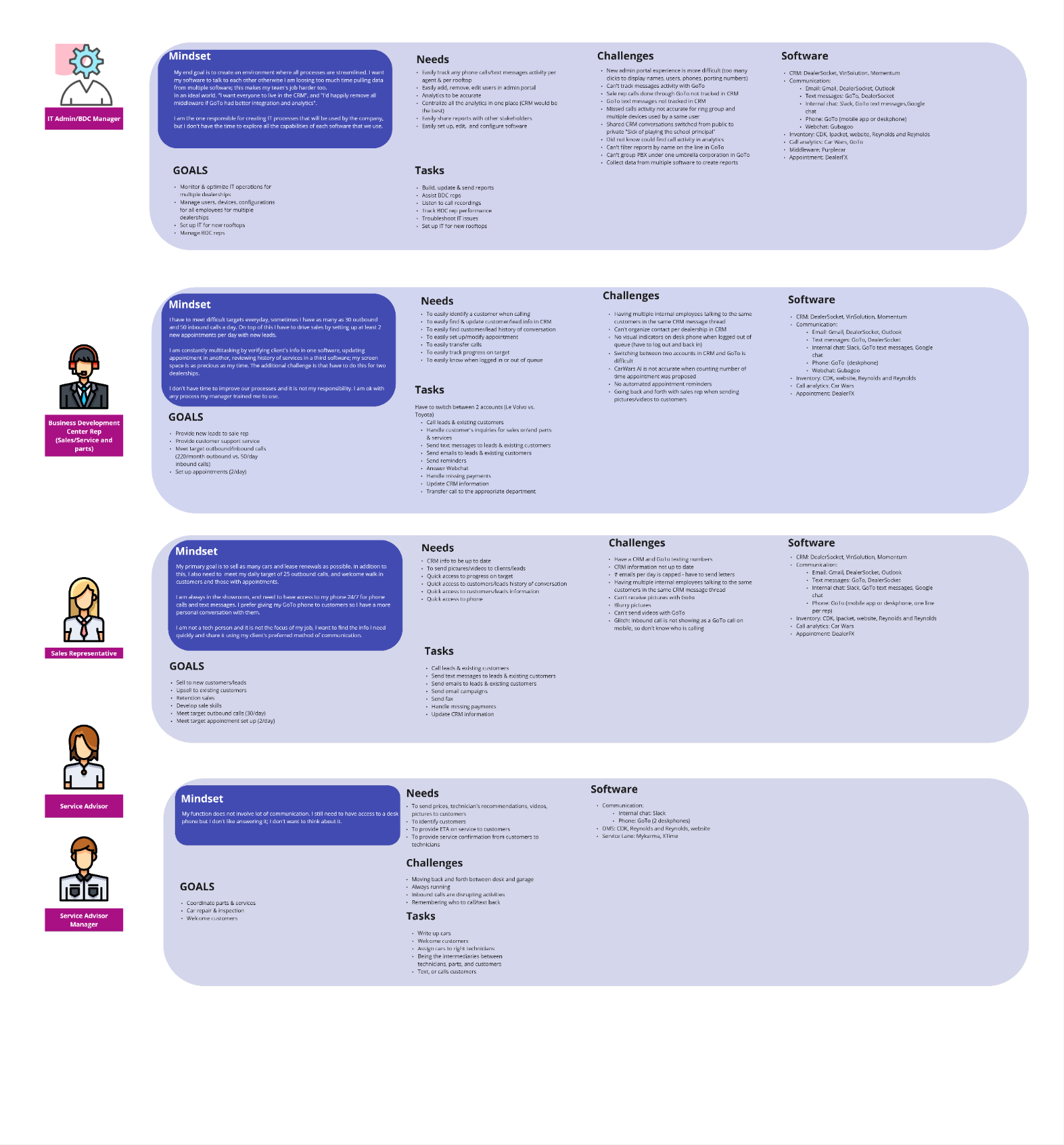
Key personas
Five personas identified who would benefit the most from GoTo. Enhancing their current experience was critical for adoption and sales.
- Business Development Manager / IT Admin
- Sales Manager
- Sales Representatives
- Service Managers
- Service Representatives
Journey map
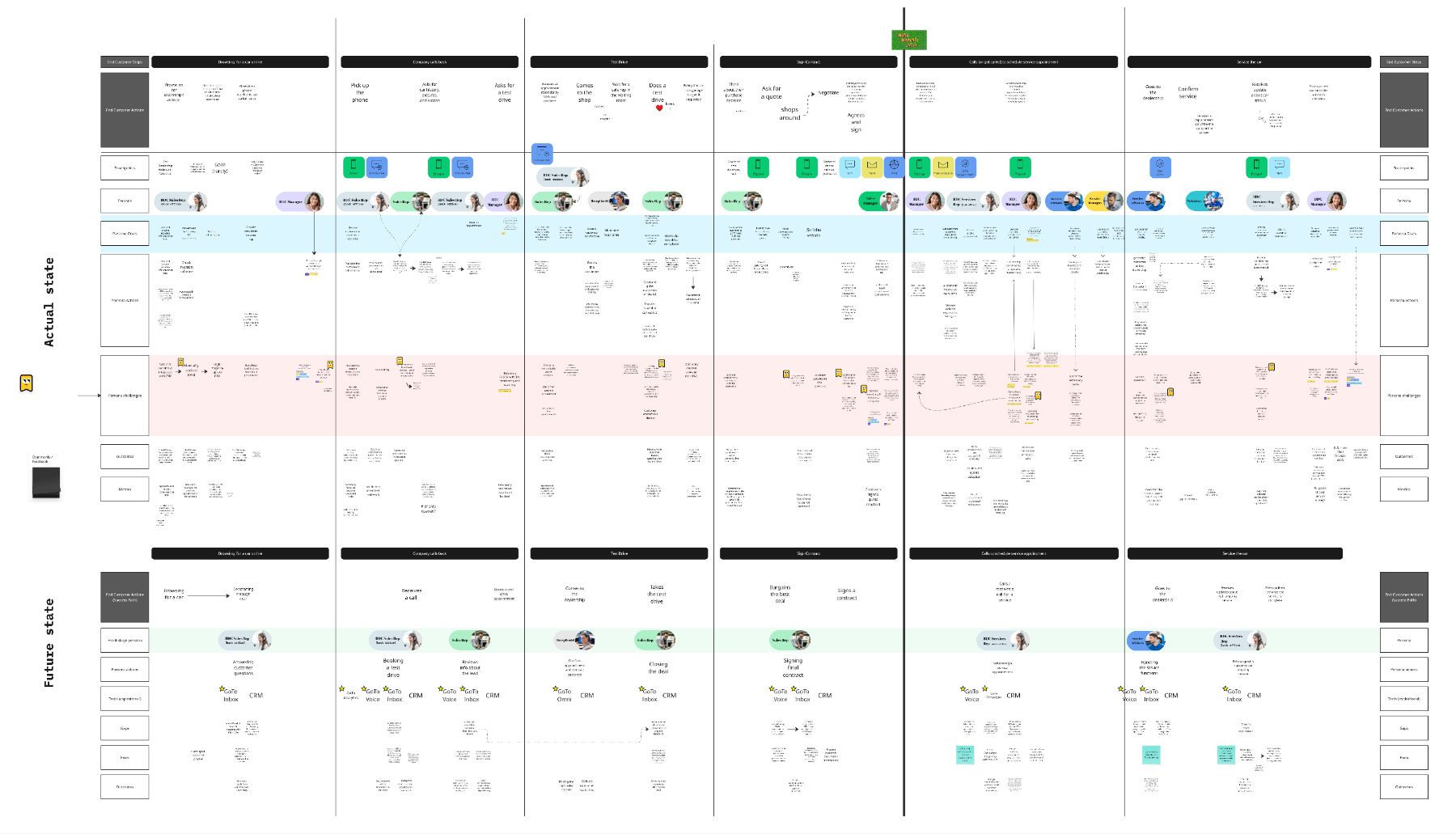
The journey map was the artefact that got the whole trio arguing about the same thing. It showed how a single customer enquiry actually travels through a dealership, across channels and across roles, and that made both the gaps and the opportunities impossible to ignore. Four things came out of it:
-
1.
A shared picture of how information has to flow
The team could finally see how an enquiry moves between channels and hands off between personas, rather than each of us holding a different mental model of it.
-
2.
The gaps in our current product
Every point where the existing platform dropped context, forced a workaround or simply stopped short became visible on the map.
-
3.
Where the future opportunities were
New functionality and AI-assisted steps could be placed against real moments in the journey instead of being argued for in the abstract.
-
4.
The outcomes and metrics to benchmark against
We defined what good looked like at each stage, which gave us the success measures the roadmap and the post-launch dashboard were later held to.
Problem
Creating one journey map per persona did not reflect the end-to-end workflows GoTo was supporting.
Solution
In a workshop with UX designers and PMs, we mapped the dealership's end customers to track how information moved from one role to another within a single journey map.
Key initiatives
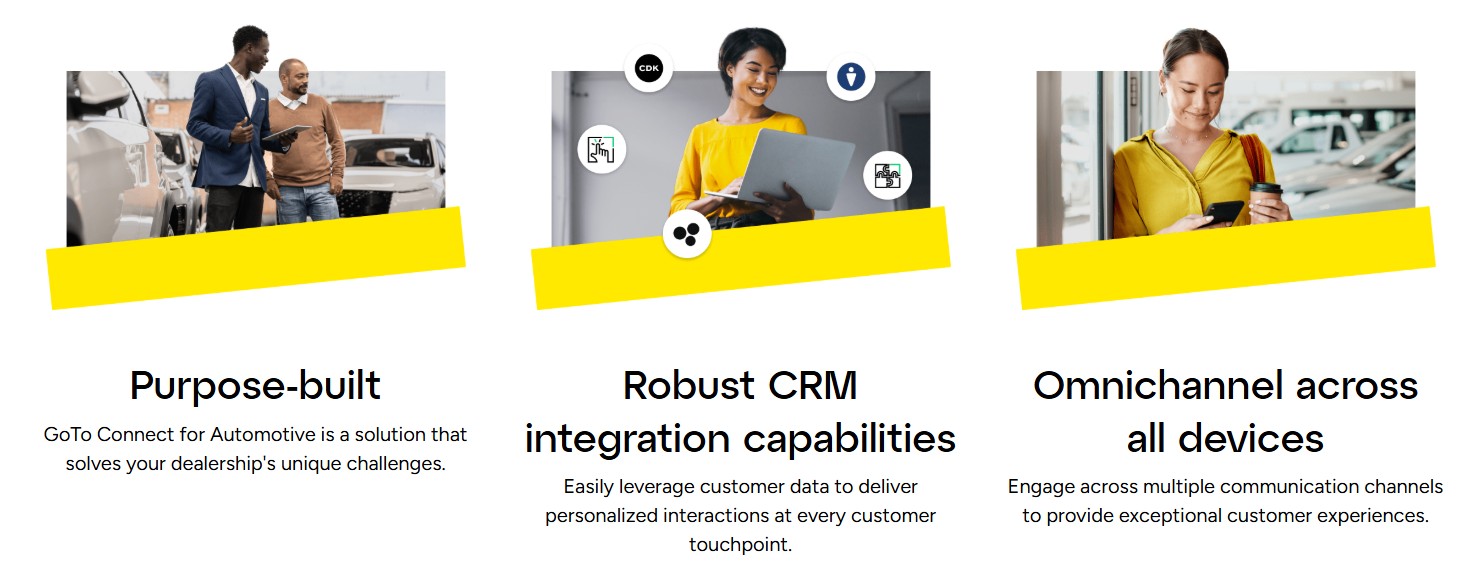
These initiatives were prioritised based on our research and the target experience we defined. Together, they form the MVP scope, addressing the highest-impact gaps and establishing the foundation for the product's next phase.
1.
Data retention
Increased to 7 years to match dealership legal requirements.
2.
Report templates
Managers don't want to build dashboards; they want to use them to improve their team's performance.
3.
DMS & CRM integrations
Dealership employees live in their CRM/DMS; integration is critical to unlock powerful automations.
4.
Image & video quality
Sales representatives rely on sending high-quality videos and images to close deals.
Testing & iteration
Multiple rounds of concept and usability testing per initiative.
1. Usability testing
Identify friction in hi-fi designs per initiative.
2. Iterate
Refine with designers based on findings.
3. Re-test
Confirm improvements before handoff.
Performance tracking
Launch was the start of the measurement, not the end of it. I built a performance dashboard in Mixpanel so the trio could see how the product was actually being adopted, week over week, against the behaviour the research said to expect.
What it tracked
- Daily active users
- Monthly active users
- Activation
- Onboarding flows
What it caught
A key activation blocker in the automation flow.
Users were dropping out of onboarding at the same step. The dashboard made the drop-off visible, we scoped the fix, and activation recovered.
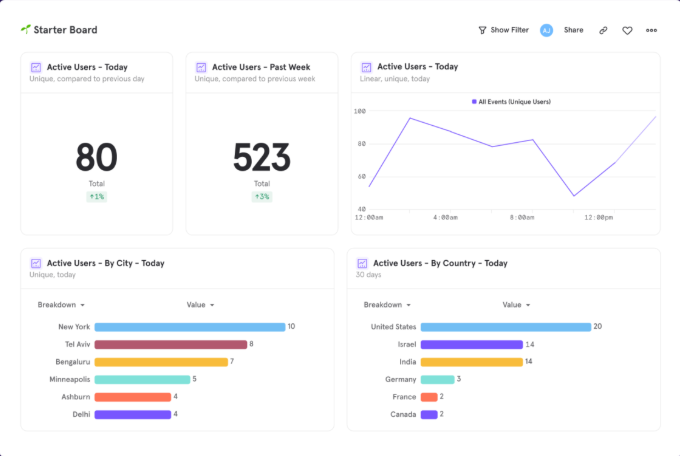
Image from the Mixpanel website, shown for illustration. The dashboard actually built for this project is GoTo's internal property and can't be shown here.
Business outcome
Target revenue met three months ahead of schedule.
A 50% win rate on sales deals, on a product built entirely against validated dealership insights.
50%
win rate on automotive sales deals
3 mo
ahead of the revenue target
6 mo
from zero industry knowledge to launch
My deliverables
A shipped product, plus the artefacts that created lasting value beyond the launch.
-
1.
A launched product, shown at NADA
GoTo Automotive shipped and went to market, presented on the floor of the NADA Show in Las Vegas, the largest car dealership convention in the world.
-
2.
Personas
Detailed profiles for key dealership roles with goals, workflows and GoTo usage patterns.
-
3.
User journey maps + JTBD
Current-state journey maps with jobs-to-be-done for each persona.
-
4.
Customer pipeline
A panel of 80 automotive customers available for continuous research and interviews.
-
5.
Marketing case studies
Customers providing real-world success stories for go-to-market and sales enablement.
-
6.
Knowledge base
A car dealership research repository accessible across the company.
Want the detail this page leaves out?
Get in touch